
DESCRIPTION
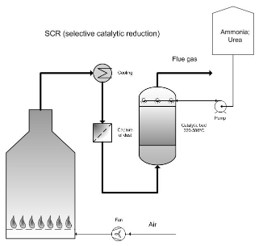
REMOVED COMPONENTS
- Nitrogen oxides (NOx) as the primary target component with an efficiency of 90-94%.1
- Sulfur dioxide (SO2) is indirectly targeted.
FUNCTION IN CCU VALUE CHAIN
- Feed gas pretreatment.
- Reduction of NOx in the flue gas.
- Protects the integrity of CO2 capture systems.
LIMITATIONS
- Impurities in flue gas can cause solvent and catalyst degradation.
- Ammonia slip (NH3) could be around 2 ppm,2 if the injected ammonia is not fully utilized in the reaction with NOx.
- Temperature sensitivity, the catalyst in SCR systems has typical operational temperatures (200–500 °C).1
ENERGY
- Primary electricity is used for operating pumps, fans, and other equipment.
- Heating is generally not required for the SCR system since it relies on the heat present in the flue gas.
CONSUMABLES
- Ammonia (NH3) at 29 wt.% concentration2 or Urea (CH4N2O) used for NOx reduction.
- The catalyst needs to be replaced. Catalyst lifetime depends on the flue gas. It varies from 40,000 – 60,000 hours for oil and gas-fired units.2
| Parameter | Value |
|---|---|
| Ammonia (kg/tNOX) * | 3332 - 3701 |
| Electricity (kWh/tNOx) | ~35302 |
| Catalyst (m3/tNOx/hr) ** | ~7882 |
|
* Depends on the NOx concentration ** Replaced every 3 years |
|
COSTS
The cost of installing an SCR system can vary significantly based on several factors, including the size of the unit, the type of ammonia system used, and the NOx removal efficiency design basis. Generally, the cost is around €4000 per tonne of NOx removed.3 Another source ranges the NOx removal cost from €2480 – €2665 per tonne of NOx removed.2 The larger units tend to have lower costs per ton of NOx removed compared to smaller units.
2 Flue gas from coal boiler; inlet NOx rate – 0.19 t/hr; NOX removal efficiency – 85%; 2016 euros, catalyst lifetime – 24,000 hours; operational time – 8760 hours; electricity price – 32.5 €/MWh; 29 wt.% ammonia solution price – 90 €/t.
TECHNOLOGY PROVIDERS
- SCR system by Babcock & Wilcox, USA
- SCR system and catalyst by Shell, UK
- SCR system by Alstom, France
- SCR system by Mitsubishi Heavy Industries, Japan
- SCR Technology by GEA, Germany
ALTERNATIVE TECHNOLOGIES
- Selective non-catalytic reduction (SNCR) is a simpler, lower-cost technology that injects a reagent (ammonia or urea) directly into the flue gas stream at high temperatures (850–1050°C).4
- Chemical absorption, which involves chemical absorption of NOx, is often integrated into systems designed for multi-pollutant control.5
Belco® Wet Scrubbing by Elessent Clean Technologies, USA
- Catalytic filters (e.g., catalytic bag filters or candles) combine particulate removal with NOx reduction in a single unit.
CataFlex™ by Topsoe, Denmark
CONTACT INFO
Mohammed Khan (mohammednazeer.khan@vito.be)
Miet Van Dael (miet.vandael@vito.be)
ACKNOWLEDGEMENT
This infosheet was prepared as part of the MAP-IT CCU project funded by VLAIO (grant no. HBC.2023.0544).
REFERENCES
1. EMIS VITO. Selective catalytic reduction. 2020
2. Sorrels JL, Randall DD, Schaffner KS, Richardson Fry C. Selective Catalytic Reduction. In: ; 2019.
3. Thunder Said Energy. Selective Catalytic Reduction Costs. 2025
4. EMIS VITO. Selective non-catalytic reduction. 2020
5. Barlow H, Shahi SSM. State of the Art: CCS Technologies 2024.; 2024.