
DESCRIPTION
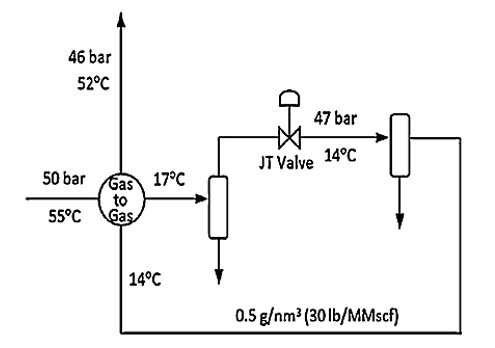
REMOVED COMPONENTS
- Water vapor (H2O) is the primary target component.
FUNCTION IN CCU VALUE CHAIN
- Purification – this is crucial to prevent corrosion and hydrate formation, which can block pipelines or damage equipment.
- Ensuring process efficiency – high purity CO2 is required for many CCUS applications.
- Facilitating transport and storage to prevent water from freezing during the compression or liquefaction of CO2.
LIMITATIONS
- Energy requirements due to cooling and compression of the gas stream.
- High capital costs, especially for multi-stage (large-scale) refrigerant systems.
ENERGY
- Electricity is used to power refrigeration compressors and cooling systems.
CONSUMABLES
- Refrigerants in a closed-loop system may need some make-up.
| Parameter | Value1 |
|---|---|
| Electricity (MWh/tCO2) | 0.037 |
| Cooling duty (MWh/tCO2) | 0.016 |
| *All values estimated for both coal-based and NGCC-based power plants1 | |
COSTS
Dehydration costs depend on the water concentration in the CO2 stream. Higher water levels require more energy for purification, increasing overall costs.
Total purification cost: 2.7 – 4.8 €/tCO2 1*
*includes both oxygen and water removal; lower range for coal-fired case and upper range for NGCC case; use CO2 stream compositions from the table below to convert the values to per ton of water.
1 Oxygen limit – 10 ppmv; water limit – 50 ppmv; palladium catalyst cost – 600,000 €/m3; catalyst lifetime – 5 yrs; hydrogen – 23 €/kg; plant lifetime – 25 yrs; operating hours – 7446 hr/yr; discount factor 8%; CFR 0.0937; electricity price 38 €/MWh; cooling water price – 0.24 €/m3; 2012 euros.
| Component | Coal base case | With purif. | NGCC base case | With purif. |
|---|---|---|---|---|
| CO2 (mol%) | 99.14 | 99.91 | 99.06 | 99.85 |
| H2O (mol%) | 0.774 | 50.1 | 0.774 | 48 |
| O2 (ppmv) | 67.6 | 11.4 | 317 | 10.3 |
| N2 (mol%) | 0.0756 | 0.0762 | 0.134 | 0.135 |
| Ar (ppmv) | 11.3 | 11.4 | 22.5 | 23.4 |
| CO2 flow (t/h) | 515 | 515 | 125 | 125 |
TECHNOLOGY PROVIDERS
- Joule-Thomson effect gas conditioning modules by Flargent, Argentina
- Joule-Thomson system by GPR, United States
- Joule-Thomson plant for natural gas by CROFT, United States
- Joule Thomson skid package for natural gas by Rushton, Canada
ALTERNATIVE TECHNOLOGIES
- Absorption process: Water vapor is absorbed into a liquid desiccant, such as triethylene glycol (TEG). The saturated desiccant is then regenerated by heating to remove water and the TEG to be recycled.2,3
- Adsorption process: This process uses solid adsorbents, such as zeolites, to adsorb water molecules. Regeneration is done by heat or pressure swing.2,3
CONTACT INFO
Mohammed Khan (mohammednazeer.khan@vito.be)
Miet Van Dael (miet.vandael@vito.be)
ACKNOWLEDGEMENT
This infosheet was prepared as part of the MAP-IT CCU project funded by VLAIO (grant no. HBC.2023.0544).
REFERENCES
1. Abbas Z, Mezher T, Abu-Zahra MRM. CO2 purification. Part II: Techno-economic evaluation of oxygen and water deep removal processes. Int J Greenh Gas Control. 2013;16:335-341.
2. Abbas Z, Mezher T, Abu-Zahra MRM. CO2 purification. Part I: Purification requirement review and the selection of impurities deep removal technologies. Int J Greenh Gas Control. 2013;16:324-334.
3. Bilsbak V. Conditioning of CO2 Coming from a CO2 Capture Process for Transport and Storage Purposes. Norwegian University of Science and Technology; 2009. http://www.diva-portal.org/smash/get/diva2:348870/FULLTEXT01.pdf