
Process overview
Mineralisation is a powerful technology that valorises alkaline waste streams and CO2 to produce construction materials. A well-known case, already commercialized in Belgium, is to produce pre-shaped elements out of steel slags for which otherwise no good valorisation options are available. Once cured with CO2, stable mineral carbonates are formed which give strength to the materials, allowing them to be used as for example masonry or facing bricks.
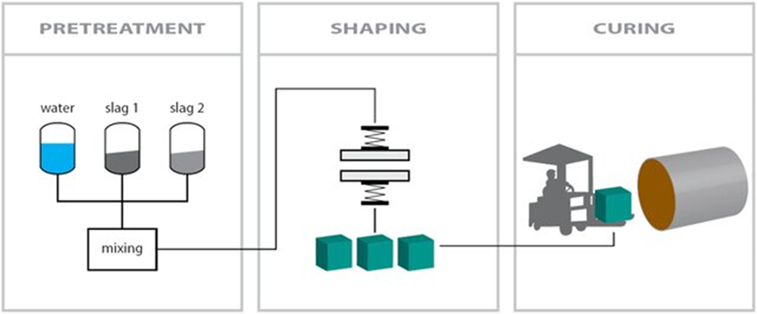
Source: QUAGHEBEUR, M., et al. Frontiers in Energy Research, 2015, 3: 52.
Apart from pre-shaped elements, it is also possible to produce synthetic aggregates via mineralization, which can replace natural aggregates such as sand, gravel, and crushed stone for use in concrete. Many potential starting materials exist, including ashes from thermal processes and steel slags. Of particular interest is to start from recycled concrete, which is very abundant. This recycled concrete is usually crushed resulting in several fractions, among which the coarser fraction is suitable for re-use as recycled aggregate, although the quality is not the same as virgin aggregates. Research has indicated that carbonation can help to improve the quality of those recycled aggregates, and already a few companies are putting this into practice.
From the finer fractions in recycled concrete, there is the possibility to produce supplementary cementitious materials (SCMs), again via carbonation. This is still in research stage but could also be an important tool to reduce the CO2 emissions related to cement production. Altogether, mineralisation could play a key role to promote recycling of construction materials.
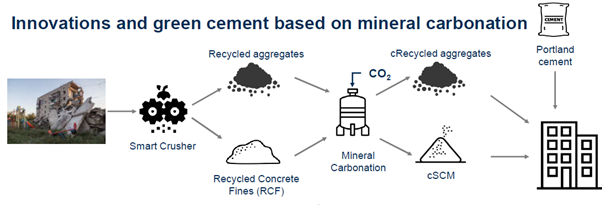
Source: VITO
Scale and CO2 purity requirements
Mineralisation reactions are thermodynamically favourable and do not necessarily require high pressures and purity levels to achieve good conversion rates. However, at very low CO2 concentrations the reactions will proceed slowly, which may not be a cost optimal strategy. While it is still subject of research, a CO2 concentration of ~20% is considered to be the minimum for carbonated blocks. For cSCMs, lower CO2-concentrations might also be feasible.
In terms of scale, for pre-shaped elements the expectation is that commercial plants will require a CO2 input of about 30 kton/yr. Since CO2 in such applications takes up only a limited share of the mass (roughly 5-15%), a very large CO2 source is not required to reach significant output volumes.
For recycled aggregates, plants are in operation today that have a CO2 feed below 1 kton/yr. Clearly, it remains to be seen how this sector evolves and whether higher scales eventually will be required, yet it is clear that mineralisation is an interesting CO2 utilisation option for smaller point sources.
Policy aspects
A major advantage of mineralisation routes, from an environmental point of view, is that the CO2 forms very stable carbonates and remains fixed in the material. This has been recognised by EU policy, more concretely the Emission Trading Scheme (ETS) where since 2024 a carbon tax is no longer due on CO2 sent to certain mineralisation applications. Apart from that, there are no specific policy targets or instruments deployed.