
DESCRIPTION
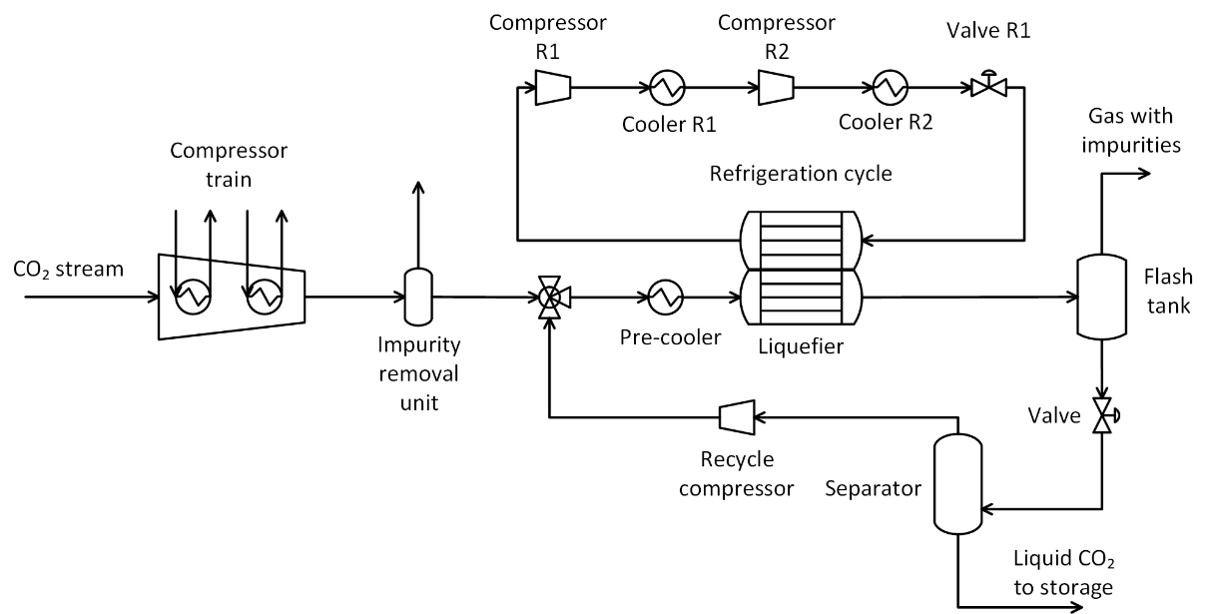
REMOVED COMPONENTS
- Water is removed as condensate after every compression stage.
- Other impurities, if any, are also removed before the liquefaction step.
FUNCTION IN CCU VALUE CHAIN
- Liquefy CO2 for transportation either by shipping, truck, rail or pipelines. For shipping, the CO2 may be compressed between 6.5-15 bar (low to medium pressure shipping, but requires sub-zero temperatures (-50 to -30 °C).3 The typical transport temperature and the corresponding pressure in Northern lights project is -30 °C and 15-21 bar.4
LIMITATIONS
- The liquefaction approach necessitates CO2 transportation at sub-zero temperatures.
- Careful assessment of the refrigeration process is critical in the liquefaction approach for accurate system power accounting.
ENERGY
- Electricity is consumed by the initial CO2 compressors and the recycle compressor.
- Electricity is also consumed by the refrigeration cycle compressors.
CONSUMABLES
Cooling water is used for cooling in the CO2 compression train and refrigeration cycle. It is generally recycled and not consumed.
| Parameter | Value |
|---|---|
| Electricity (kWh/tCO2) | 90 - 96 5 * |
| Cooling water make-up (t/tCO2) | 0.4** |
|
* Pure CO2. Target transport pressure from 8 – 16 bar. Higher impurities result in higher electricity consumption. ** VITO study |
|
COSTS
The cost of CO2 liquefaction is also variable depending upon the captured CO2 purity and target transport pressure. The cost to liquefy at a scale of 1 MtCO2/yr of pure CO2 ranges from €14 – €15 per tonne CO2 at target transport pressures 8 – 16 bar.5 For high-pressure liquefaction, mild cooling temperatures are sufficient. The cost to liquefy CO2 at 66 bar at 20 °C using a flash and a distillation column was reported to be €12 – €18 and €16 – €17 per tonne CO2, respectively.6
TECHNOLOGY PROVIDERS
- CO2 liquefaction by Linde, Ireland.
- Cryocap™ LQ by Air Liquide, France.
- CO2 liquefaction by Baker Hughes, USA.
- CarboPac-L by Bright Renewables, Netherlands.
- CO2 liquefaction by GEA, Germany
ALTERNATIVE TECHNOLOGIES
Compression: CO2 is compressed up to 80 bar and cooled to obtain the supercritical phase, and then pumped to pressures up to 150 bar. This CO2 phase is more suitable for pipeline transport and does not require a refrigeration cycle.
CONTACT INFO
Mohammed Khan (mohammednazeer.khan@vito.be)
Miet Van Dael (miet.vandael@vito.be)
ACKNOWLEDGEMENT
This infosheet was prepared as part of the MAP-IT CCU project funded by VLAIO (grant no. HBC.2023.0544).
REFERENCES
1. Linde. CO₂ purification and liquefaction. Published online 2017:8.
2. Powermag. Capturing CO2: Gas Compression vs. Liquefaction. June 1, 2009. Accessed October 29, 2024. https://www.powermag.com/capturing-co2-gas-compression-vs-liquefaction/
3. NOV. CO2 Dehydration Product Offerings.; 2024. https://www.nov.com/-/media/nov/files/capabilities/carbon-capture-utilization-and-storage-solutions/co2-dehydration-product-offerings-brochure.pdf
4. Northern Lights. Northern Lights’ first CO2 transport ship ready for delivery. November 25, 2024. Accessed May 12, 2025. https://norlights.com/news/northern-lights-first-co2-transport-ship-ready-for-delivery/
5. Roussanaly S, Deng H, Skaugen G, Gundersen T. At what Pressure Shall CO2 Be Transported by Ship? An in-Depth Cost Comparison of 7 and 15 Barg Shipping. Energies. 2021;14(5635):1-27.
6. Kim S, Jung PG, Lim Y Il, Kim H, Moon HM. CO2 Compression and Liquefaction Processes Using a Distillation Column for the Flexible Operation of Transportation. Process 2024, Vol 12, Page 115. 2024;12(1):115.