
DESCRIPTION
REMOVED COMPONENTS
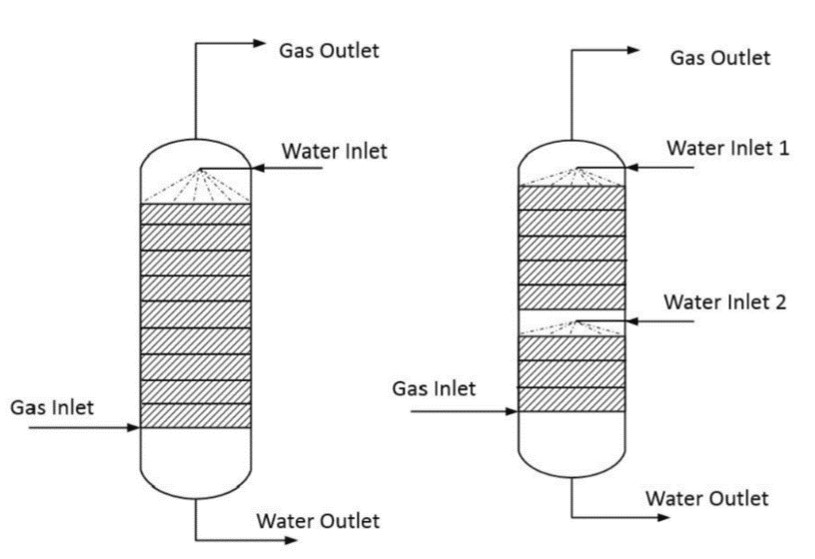
- Removes moisture from flue gas.
- Removes impurities such as particulates, sulfur oxides (SOx), and nitrogen oxides (NOx) from the flue gas in minor quantities.4
FUNCTION IN CCU VALUE CHAIN
By cooling the flue gas and removing impurities, the DCC improves the overall efficiency and effectiveness of the CO2 capture process.
LIMITATIONS
- This is a secondary scrubbing process to remove trace amounts of contaminants to minuscule quantities and is not a replacement for traditional emission control technologies, like SOx scrubbers, selective catalytic reduction (SCR) for NOx removal, ESPs to remove ash, etc.5
- To ensure low maintenance and reduced pressure drop in the DCC, the flue gas should be largely free of dust and pollutants. Otherwise, any buildup inside the cooler will need to be flushed out through blowdown and subsequently treated as waste.6
ENERGY
Electricity is consumed by the process water circulating pump.
CONSUMABLES
The cooling water is mostly recycled, but a small volume of process water make-up stream is required.7
| Parameter | Value* |
|---|---|
| Electricity (kWh/tCO2) / (kWh/m3 gas) |
1.6 / 0.0001 |
|
Cooling water (t/tCO2) / (t/m3 gas) |
13.2 / 0.0008 |
|
*CAPTIN project: estimated values; flue gas flowrate = 1016 m3/s; 4.6 vol.% CO2; 9.5 vol.% H2O; gas temperature = 90 °C; gas pressure = 1.02 bar; cooled gas temperature = 40 °C. **Cooling water is recycled and not consumed. |
|
COSTS
The cost of flue gas cooling depends on the gas temperature and moisture content. Cost data is not available in the literature, but an estimate from the CAPTIN project shows that it will be in the range €4 - €5 per tonne CO2 captured (or) €0.002 – €0.003 per m3 flue gas.
TECHNOLOGY PROVIDERS
- Direct Contact Cooler by Babcock & Wilcox, USA.
- Direct Contact Cooler by GEA, Germany.
- Direct Contact Cooler by Linde, Ireland. (Linde provides as part of complete gas treatment for CO2 capture.)
- Direct Contact Cooler by GEA, Germany.
ALTERNATIVE TECHNOLOGIES
Various designs are available, such as spray coolers, water recycled gas quencher, dry bottom evaporative cooler, etc.6
CONTACT INFO
Mohammed Khan (mohammednazeer.khan@vito.be)
Miet Van Dael (miet.vandael@vito.be)
ACKNOWLEDGEMENT
This infosheet was prepared as part of the MAP-IT CCU project funded by VLAIO (grant no. HBC.2023.0544).
REFERENCES
1. Verma P, Yang Z, Axelbaum RL. A direct contact cooler design for simultaneously recovering latent heat and capturing SOx and NOx from pressurized flue gas. Energy Convers Manag. 2022;254(x):115216.
2. Adams D. Flue Gas Treatment for CO2 Capture. IEA Clean Coal Centre; 2010.
3. Power-Eng. Optimizing Post-Combustion Carbon Capture. September 6, 2017. Accessed November 7, 2024. https://www.power-eng.com/emissions/optimizing-post-combustion-carbon-capture/
4. Reddy S, Scherffius JR, Yonkoski J, Radgen P, Rode H. Initial results from fluor’s CO2 capture demonstration plant using econamine FG PlusSM technology at E.ON Kraftwerke’s wilhelmshaven power plant. In: Energy Procedia. Vol 37. Elsevier Ltd; 2013:6216-6225.
5. Haffner R. Solvent-Based Post Combustion Carbon Capture. POWER Engineers. 2024. Accessed August 11, 2024. https://www.powereng.com/library/solvent-based-post-combustion-carbon-capture
6. D’Hubert X. Flue Gas Cleaning to Optimize CO2 Capture. In: AISTech - Iron and Steel Technology Conference Proceedings. AIST; 2024:128-141.
7. Brown A, Meuleman E, Heller G, et al. ION Engineering Final Project Report National Carbon Capture Center Pilot Testing.; 2017. https://www.nationalcarboncapturecenter.com/wp-content/uploads/2021/01/ION-Engineering-ION-Advanced-Solvent-CO2-Capture-Project-2015.pdf