
DESCRIPTION
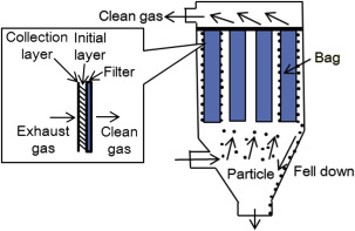
REMOVED COMPONENTS
- Particulate matter (PM): dust, ash, soot, and other fine particulates up to >99%.3
- Partially removes sulfur dioxide (SO2) and nitrogen oxides (NO2 and NO) when appropriate materials are used in the bag filters.2
- Also removes trace amounts of heavy metals present in the gas stream.
FUNCTION IN CCU VALUE CHAIN
- Enhancing CO2 capture efficiency.
- Ensuring flue gas purity for utilization.
- Protection of carbon capture equipment.
- Improving operational stability and safety.
LIMITATIONS
- Filter clogging: high particulate loads can lead to frequent clogging, requiring more maintenance.4
- Temperature sensitivity: Bag filters are not suitable for extremely high-temperature gas streams.
- Chemical compatibility: filter media must be compatible with the chemical composition of the gas stream to avoid degradation.
ENERGY
- Electricity is mainly used to power the fans and is also used to control the gas stream temperature.
CONSUMABLES
- Filter bags need regular replacement due to wear and degradation.
| Parameter | Value |
|---|---|
| Electricity (kW per m3/s gas) * | 0.8 – 2.04 |
| * Power requirement for a reverse air fabric filter with a typical dust loading of 0.2 – 20 g/m3 gas. | |
COSTS
The cost of collecting dust and particulate matter from flue gas using fabric filters can vary based on several factors, including the size of the system, the type of fabric filter, and the specific application. The average cost ranges based on gas flow rate from €58 - €372 per tonne of particulate matter removed.5
5 gas flow rates – 1 to 470 m3/s; particulate matter loading – 9 g/m3; 1999 euros.
TECHNOLOGY PROVIDERS
- Fabric filter (FF) by Andritz Group, Austria
- Pulsed Jet Fabric filters by Babcock & Wilcox, USA
- Eco Pulser™ by Sumitomo Heavy Industries, Japan
- Bagfilter (Ecopuls) by GEA, Germany
ALTERNATIVE TECHNOLOGIES
- Electrostatic precipitators (ESP) use electrostatic forces to remove dust from flue gases. They charge particles negatively, which then move to positively charged plates. The collected dust is dislodged and collected by electrode rapping.6
Wet and Dry ESP by Babcock & Wilcox, USA.
Wet and Dry ESP by GEA, Germany.
- Cyclone separators use centrifugal forces to separate particulates.3
- Wet scrubbers use liquid to wash out particulates from the gas stream.3
Wet gas scrubber by Babcock & Wilcox, USA.
- Ceramic filters remove particulate matter and acidic gases with very low dust emissions and are thermally stable under high operating temperatures.
Ceramic Candle Filter by GEA, Germany.
CONTACT INFO
Mohammed Khan (mohammednazeer.khan@vito.be)
Miet Van Dael (miet.vandael@vito.be)
ACKNOWLEDGEMENT
This infosheet was prepared as part of the MAP-IT CCU project funded by VLAIO (grant no. HBC.2023.0544).
REFERENCES
1. Li C, Huangfu L, Li J, Gao S, Xu G, Yu J. Recent advances in catalytic filters for integrated removal of dust and NOx from flue gas: fundamentals and applications. Resour Chem Mater. 2022;1(3-4):275-289.
2. Wang C, Li J. Application of bag filter in integrated technology of dry desulfurization and dust collection. IOP Conf Ser Earth Environ Sci. 2020;467(1).
3. Larki I, Zahedi A, Asadi M, et al. Mitigation approaches and techniques for combustion power plants flue gas emissions: A comprehensive review. Sci Total Environ. 2023;903(May):166108.
4. Sjoholm P, Ingham DB, Lehtimaki M, Perttu-Roiha L, Goodfellow H, Torvela H. Gas-Cleaning Technology. In: Industrial Ventilation Design Guidebook. ACADEMIC PRESS; 2001:1197-1316.
5. EPA. Air Pollution Control Technology Fact Sheet - Fabric Filter.; 1999.
6. IEA. CO2 CAPTURE IN THE CEMENT INDUSTRY.; 2008. Accessed November 30, 2021. www.ieagreen.org.uk